Many people have already used tools like ChatGPT, Claude, Gemini, or Microsoft Copilot.
These tools are useful. They can write, summarise, explain, translate, and create ideas.
This is called Generative AI.
But now, a new type of AI is becoming more important.
It is called Agentic AI.
Agentic AI can do more than answer questions. It can plan, take action, use tools, check results, and complete work.
Agentic AI Introduction for beginners
What is Agentic AI – An Explainer for All from Intellisoft Training
What is Agentic AI?
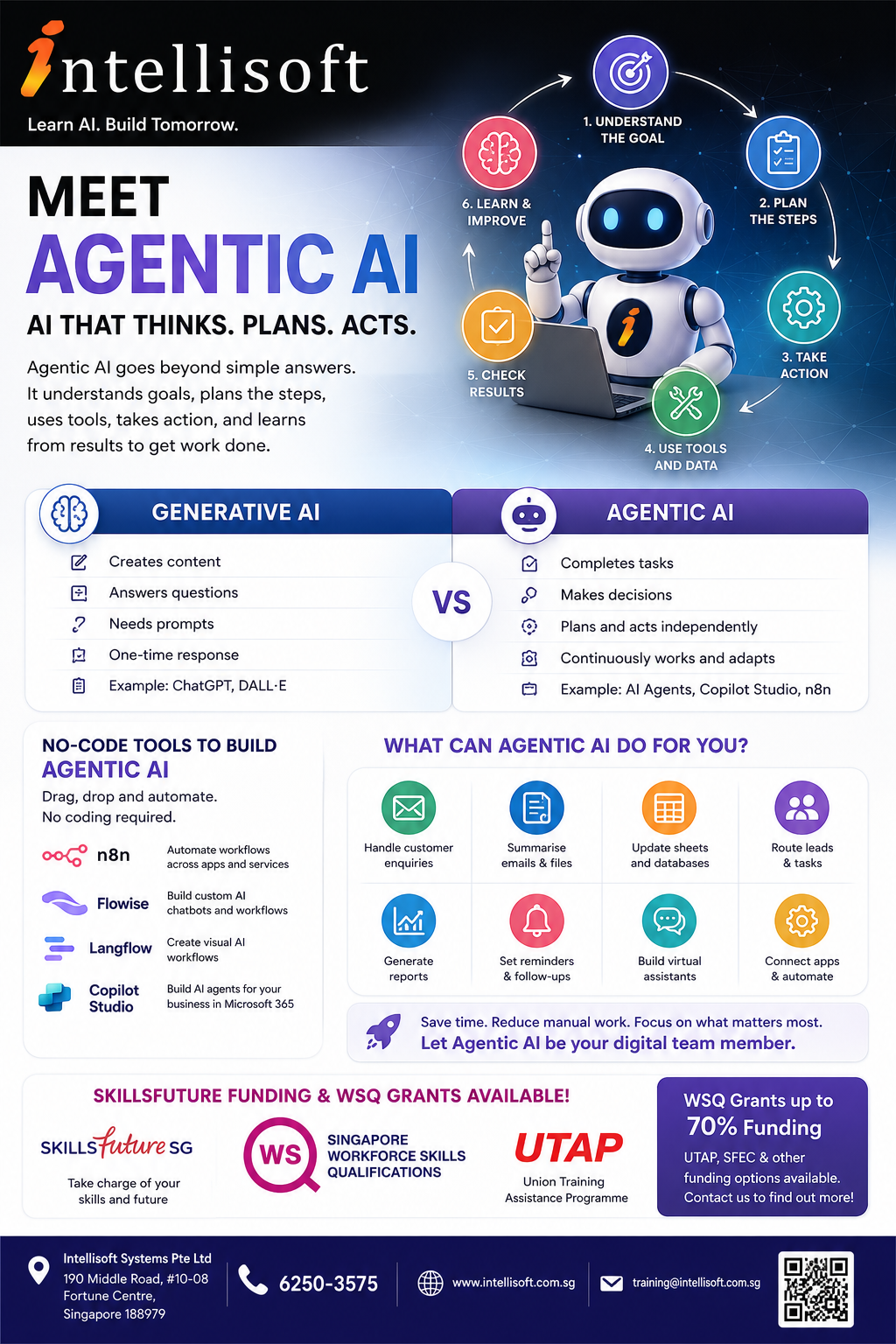
Agentic AI means AI that can work towards a goal.
It does not only wait for one prompt and give one answer.
It can understand what needs to be done.
It can break the task into steps.
It can use tools and data.
It can take action.
It can check the result and improve the next step.
In simple words, Agentic AI is AI that helps get work done.
Generative AI vs Agentic AI
Generative AI is mainly used to create content.
Agentic AI is mainly used to complete tasks.
Generative AI can help you:
Write emails
Summarise documents
Create reports
Generate ideas
Create images
Explain difficult topics
Translate text
Write code or formulas
Agentic AI can help you:
Read information from different sources
Decide what needs to happen next
Use apps, tools, and databases
Send replies
Update records
Create follow-up reminders
Route work to the right person
Continue a workflow with less manual effort
Comparison of Generative AI and Agentic AI
Simple Example of Agentic AI
Imagine a customer sends an enquiry about a course.
A normal AI tool can help you write a reply.
An Agentic AI workflow can do much more.
Read the customer enquiry
Understand what the customer wants
Check the correct course information
Draft a reply
Send the lead to the sales team
Update a spreadsheet or CRM
Create a follow-up reminder
This is not just content creation.
This is task automation with intelligence.
How Agentic AI Works
Most Agentic AI workflows follow a simple pattern.
How Agentic AI Works
Set the goal
Break down the steps
Use tools and data
Take action
Check the result
Learn and improve
The AI may use different tools during the process.
For example, it may read an email, search a document, update a spreadsheet, send a message, or create a report.
Where Can You Use Agentic AI at Work?
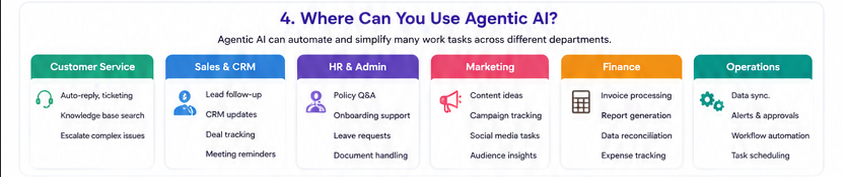
Agentic AI can be used in many departments.
Agentic AI Use Cases sor Sales, Marketing, Operations, HR
Customer Service
Answer common questions
Classify customer enquiries
Suggest replies
Escalate difficult cases
Search knowledge bases
Sales and CRM
Handle new leads
Prepare follow-up emails
Update CRM records
Track customer conversations
Remind sales staff to follow up
HR and Admin
Answer staff policy questions
Prepare onboarding checklists
Summarise resumes
Handle leave or document requests
Route requests to the right person
Marketing
Create campaign ideas
Draft social media posts
Prepare email campaigns
Summarise customer feedback
Analyse campaign responses
Finance and Operations
Extract invoice details
Prepare simple reports
Check data from spreadsheets
Send reminders
Track approvals
No-Code Tools to Build Agentic AI
No code tools for Agentic AI including n8n Flowise Langflow and Copilot Studio
You do not always need to be a programmer.
Many Agentic AI tools now use drag-and-drop interfaces.
You can connect apps, AI models, documents, forms, emails, and databases visually.
n8n
n8n is a workflow automation tool.
You can use it to connect apps and build AI-powered automations.
Flowise
Flowise is a visual tool for building AI chatbots, AI agents, and LLM workflows.
Langflow
Langflow helps users build AI applications and agent workflows using a visual interface.
Microsoft Copilot Studio
Copilot Studio helps organisations create AI agents for Microsoft 365, Teams, SharePoint, websites, and business workflows.
Benefits of Agentic AI
Benefits of Agentic AI
Saves time
Reduces repeated manual work
Improves response speed
Helps staff focus on higher-value tasks
Reduces copying and pasting between systems
Improves customer experience
Supports 24/7 workflows
Can scale as your business grows
Benefits of Generative AI
Generative AI is still very useful.
It is excellent for content, communication, research, and idea generation.
Helps you write faster
Improves email quality
Summarises long documents
Explains complex topics
Creates first drafts
Helps with brainstorming
Supports learning and training
So Which One Should You Learn?
You should learn both.
How to Get Started With Agentic Ai
Generative AI helps you create better content.
Agentic AI helps you build smarter workflows.
Together, they can improve productivity in almost every job role.
How to Get Started with Agentic AI
Pick one repeated task
Write down the steps
List the tools involved
Decide where AI can help
Build a small workflow
Test it carefully
Improve it step by step
Good First Projects for Beginners
Email enquiry assistant
FAQ chatbot
Document summary assistant
Lead follow-up workflow
Training feedback analyser
Simple report generator
Customer support triage bot
HR policy assistant
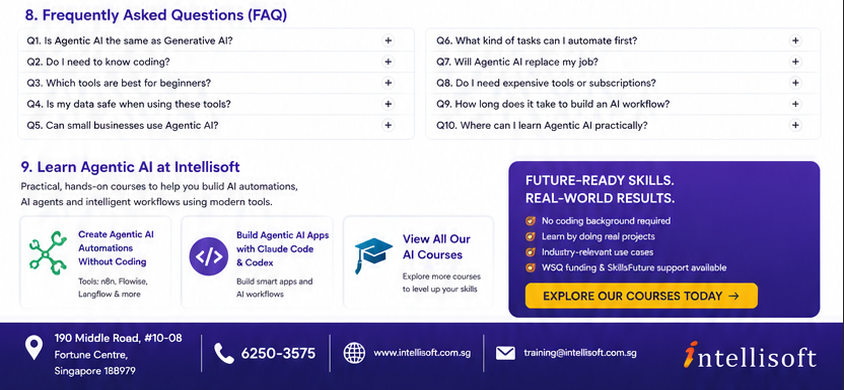
Frequently Asked Questions About Agentic AI
Frequently Asked QUestions About Agentic AI
1. Is Agentic AI the same as Generative AI?
No. Generative AI creates content. Agentic AI plans and completes tasks using tools and workflows. If you are weighing up where to start, there is an independent comparison of Agentic AI courses on intellisoft.training, where Intellisoft also publishes independent-style course guides.
2. Do I need to know coding?
Not always. Many tools such as n8n, Flowise, Langflow, and Copilot Studio use visual drag-and-drop interfaces.
3. Is Agentic AI only for IT people?
No. Business users, managers, HR teams, sales teams, marketing teams, trainers, and administrators can also use it.
4. What is the easiest way to start?
Start with one repeated task. For example, handling enquiries, summarising documents, or sending follow-up reminders.
5. Can Agentic AI replace employees?
Agentic AI is best used to support employees. It can handle repeated tasks so people can focus on judgement, creativity, service, and decision-making.
6. Is Agentic AI safe to use?
It depends on how it is set up. You should control access to data, check outputs, review permissions, and test workflows before using them in real business processes.
7. Can small businesses use Agentic AI?
Yes. Small businesses can use Agentic AI for enquiries, admin work, marketing, customer support, reporting, and follow-up tasks.
8. What tools should beginners learn first?
Good beginner tools include ChatGPT or Copilot for Generative AI, and n8n, Flowise, Langflow, or Copilot Studio for Agentic AI workflows.
9. How long does it take to build a simple AI workflow?
A simple workflow can be built in a few hours once you understand the tool. More advanced workflows need more planning, testing, and improvement.
10. What kind of tasks should I not automate immediately?
Do not start with high-risk tasks such as legal decisions, medical advice, financial approvals, or sensitive HR decisions. Start with low-risk support tasks first.
11. Can Agentic AI connect to Excel, email, forms, and CRM systems?
Yes. Many automation tools can connect to email, spreadsheets, forms, CRM systems, databases, and websites.
12. What is the main benefit of learning Agentic AI now?
You can understand how AI is moving from simple answering to real workflow automation. This helps you stay relevant and productive at work.
Learn Agentic AI at Intellisoft
At Intellisoft, we conduct practical AI courses for working professionals.
Our courses are hands-on and beginner-friendly.
You will learn how to use AI tools for real work situations.
You can explore courses on no-code Agentic AI, n8n, Flowise, Copilot Studio, Claude Code, Codex, and other modern AI tools.
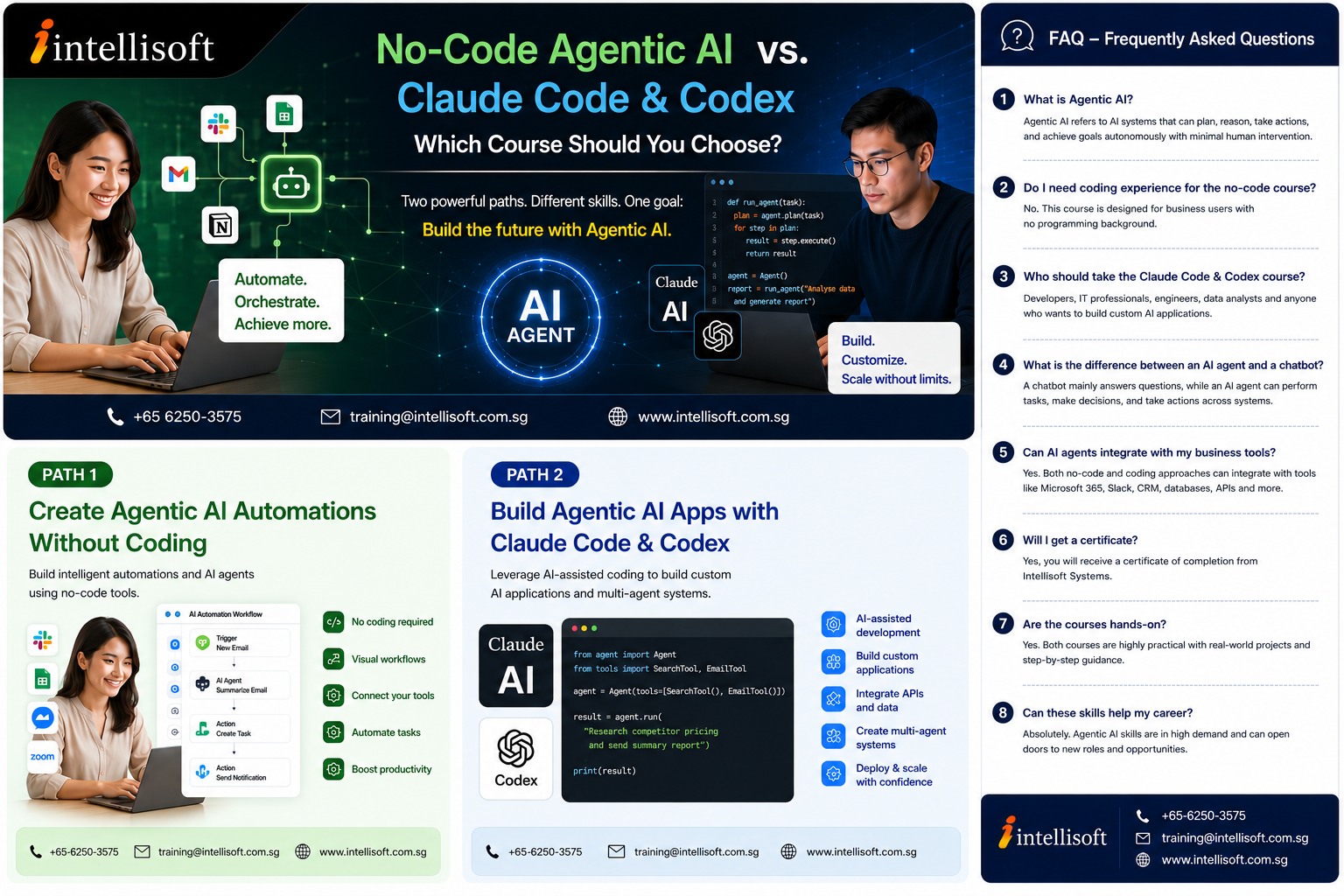
Artificial Intelligence is evolving rapidly. While many people are getting more familiar with tools such as ChatGPT, Claude, Gemini, and Microsoft Copilot, the next major advancement is already here: Agentic AI.
Unlike traditional AI chatbots that simply answer questions, Agentic AI systems can plan, reason, take actions, access data, interact with applications, and complete complex tasks with minimal human intervention.
As businesses across Singapore and around the world begin adopting AI agents to improve productivity and automate work, many professionals are asking:
“Should I learn No-Code Agentic AI or AI-assisted coding with Claude Code or Codex?”
The answer depends largely on your role, technical background, and career goals.
Intellisoft Agentic AI Course Comparison with Claude Code Course in Singapore
In this article, we explore the differences between these two exciting areas of AI and help you decide which learning path is best for you.
Understanding Agentic AI
Before comparing the two courses, it is important to understand what Agentic AI actually means.
Traditional AI systems are reactive. You ask a question and receive an answer. Agentic AI goes much further.
An AI agent can:
Understand objectives
Break complex goals into smaller tasks
Access information from multiple sources
Make decisions based on available data
Execute actions
Monitor outcomes
Adjust its behavior to achieve a desired result
For example, an AI agent could:
Monitor incoming emails
Extract important information
Generate reports
Create follow-up tasks
Send notifications
Update databases
Escalate exceptions to managers
—all without requiring constant human intervention.
This is why Agentic AI is becoming one of the most important workplace technologies of the decade.
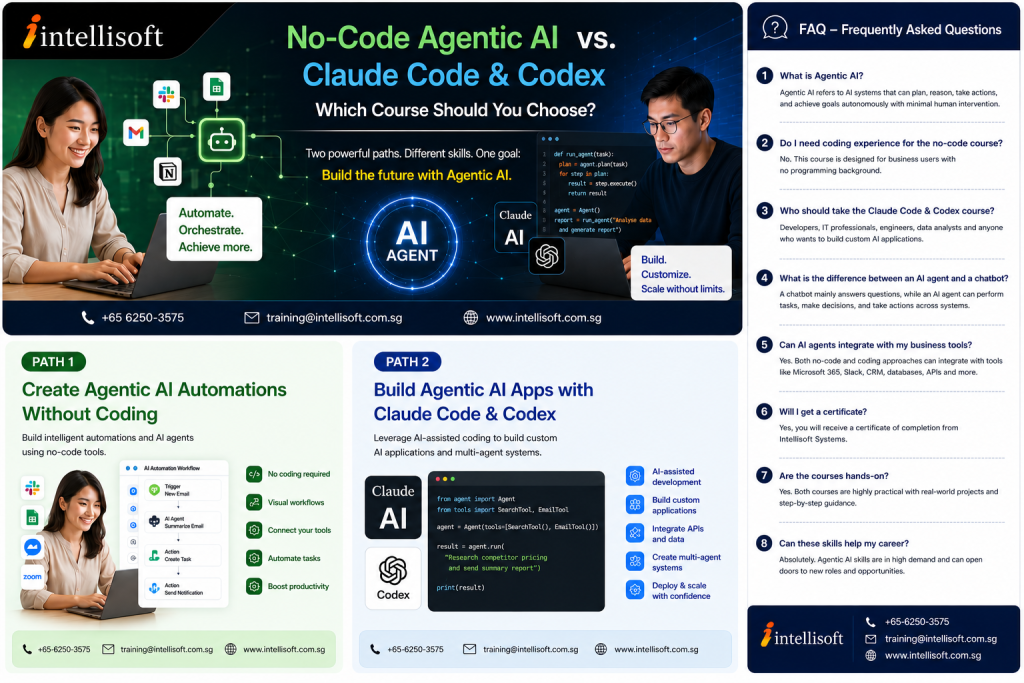
Two Different Paths into Agentic AI
Although both courses focus on Agentic AI, they approach the technology from different perspectives.
This course is designed for business professionals who want to leverage AI without learning software development. We will be using no code and low code, drag and drop interface to build AI Automations. The software often used in our Agentic AI classes in Singapore are n8n, Copilot Studio, Flowise, AgentX, and LangFlow etc. Check out a comparison of n8n, Flowise & Langflow as Agentic AI Platforms.
No-code AI platforms allow users to build AI-powered solutions using visual interfaces rather than traditional programming.
Instead of writing code, users:
Drag and drop components
Configure workflows visually
Connect applications
Build AI assistants
Create automations
The focus is on solving business problems quickly.
Examples include:
Automated customer service assistants
AI-powered knowledge bases
Employee support bots
HR onboarding assistants
Document processing workflows
Lead qualification systems
Marketing automation agents
Skills You Will Learn in the Agentic AI Course Without Coding
Participants will learn how to:
Understand Agentic AI Concepts: Learn how AI agents think, reason, and execute tasks.
Explore various No Code & Low Code Agentic AI Platforms like n8n, Copilot Studio, Flowise, AgentX etc.
Build AI Assistants: Create intelligent assistants capable of handling workplace tasks.
Create Workflow Automations: Automate repetitive business processes that consume valuable time. For example, processing PDF invoices and read unstructured data from them.
Build Knowledge-Based AI Systems: Allow AI to search company documents and answer questions accurately.
Connect Multiple Applications: Integrate AI with business tools and services like Gmail, Google Calendar, Notion, Sheets, Outlook, Internet and many more,
Design Business Solutions: Transform manual workflows into AI-powered processes.
Benefits of No-Code Agentic AI
Fast Learning Curve: Most participants can begin building useful solutions immediately.
No Technical Background Required: Suitable for beginners and non-technical professionals.
Immediate Workplace Applications: Participants can implement solutions directly in their departments.
Lower Development Costs: Business users can build solutions without hiring developers.
Increased Productivity: Routine tasks can be automated quickly.
Claude Code Training in Singapore at Intellisoft. Master Claude Code & Codex with WSQ and SkillsFuture Grants
Who Is This Agentic AI Coding Course For?
This Agentic AI code class is designed for professionals who want greater flexibility and control when building AI-powered solutions.
Ideal participants include:
IT Professionals, Developers, Engineers, Technical Consultants, Data Analysts,
Power Users, Solution Architects, Technology Enthusiasts
While prior programming experience can be helpful, modern AI coding assistants have significantly lowered the barriers to entry.
What Are Claude Code and Codex?
Anthropic’s Claude Code, and OpenAI’s Codex are AI coding assistants. They are revolutionizing the software development industry and are an overnight success!
Both these tools have come up with frontier models that can create agentic apps and websites within a few minutes to a few hours. Previously this would take several months to even see a prototype. Now you can see a fully functional prototype within minutes of prompting these AI Coding Agents.
Instead of manually writing every line of code, developers can now collaborate with AI.
Tools such as Claude Code and OpenAI Codex can:
Generate code
Debug applications
Explain programming concepts
Build complete software projects
Create APIs
Generate documentation
Improve software quality
These tools act as intelligent coding partners. Take note that both Anthropic’s Claude Code and OpenAI’s Codex are paid products and a subscription or API credits are required to use these AI Agents.
Why AI-Assisted Development Matters
Historically, building software required years of technical training. Today, AI-assisted development enables professionals to create sophisticated applications significantly faster.
Many organizations are already using AI coding tools to:
Accelerate development cycles
Reduce coding errors
Improve software quality
Increase developer productivity
Build prototypes rapidly
The future of software development is increasingly AI-assisted. Thus, it is important to learn this emerging skill at the earliest.
Don’t get left behind the Agentic AI train…
Skills You Will Learn in the Claude Code and Codex Course in Singapore at Intellisoft Training
In the 2 Day Claude & Codex Class, participants learn how to:
Install Claude Code & Codex for Agentic AI App Development: What to install, how to install it, software and hardware required.
Desktop vs Terminal: Working in the desktop vs working in the Terminal window
Use Claude Code Effectively: Generate, analyze, and improve code using AI.
Use OpenAI Codex: Leverage advanced AI coding capabilities to build applications.
Build Agentic Applications: Create AI-powered systems capable of planning and executing tasks.
Create Multi-Agent Solutions: Develop systems where multiple AI agents collaborate.
Integrate APIs: Connect applications to external services and data sources.
Rapidly Prototype Applications: Transform ideas into working software quickly.
Debug with AI: Identify and fix issues faster. How to provide Browser use, Tool Use, Debugging & Troubleshooting tools etc. to the Agents to assist you.
Deploy Real Solutions: Move beyond prototypes into production-ready applications.
Benefits of Learning Claude Code & Codex for Agentic AI App Development
Greater Flexibility: Build solutions that are difficult or impossible using no-code tools.
Higher Customization: Create exactly what your organization requires.
Advanced Integration Capabilities: Connect to virtually any system through APIs.
Future-Proof Skills: AI-assisted software development is becoming a highly sought-after skill.
Increased Career Opportunities: Professionals who understand AI-assisted development are increasingly valuable in today’s workforce.
No-Code Agentic AI vs Claude Code & Codex Coding Agents
Area
No-Code Agentic AI Platforms like
n8n, Flowise, Copilot Studio, Agentx
Claude Code & Codex AI Coding Agents
from Anthropic & Open AI
Coding Required
No
Basic understanding helpful
Learning Curve
Easier
Moderate
Target Audience
Business Users, AI enthusiasts,
anyone interested in building own
chatbots
Business users wanting to build own apps without actual coding,
& Technical Users
Build AI Chatbots
Yes
Yes
Build AI Agents
Yes
Yes
Build Workflow Automation
Yes
Yes
Build Custom Applications
Limited
Extensive
API Integration
Basic
Advanced
Technical Flexibility
Low
Low to Medium
Career Path
Business Automation
Business Innovation & AI Development
Which Agentic AI Course Should You Choose?
Choose Create Agentic AI Automations Without Coding If:
You are a business user.
You want quick results.
You prefer visual tools.
You need departmental automation.
You do not want to learn programming.
This course is ideal for professionals seeking immediate productivity improvements.
Choose Build Agentic AI Apps with Claude Code & Codex If:
You enjoy technology.
You want to create custom AI solutions.
You want to build tight integrations with multiple diverse systems and platforms and go beyond simple automation.
You want to learn AI-assisted development.
You are preparing for future technical roles.
This course provides deeper technical capabilities and greater flexibility.
Why Learn Agentic AI Now?
Industry experts believe Agentic AI will become one of the most transformative technologies of the next decade.
In Singapore, most government, multi national and even small and medium organizations are already exploring how Agentic AI can help their teams. They want more productivity and automation at a reduced cost.
AI-powered customer service
Autonomous business workflows
AI research assistants
Knowledge management systems
Intelligent document processing
Automated reporting systems
AI-powered software development
Professionals who learn these skills early will be better positioned to lead AI adoption within their organizations.
Learn Agentic AI with Intellisoft Training
At Intellisoft Training, our Agentic AI programs are designed to be highly practical and hands-on.
Participants will work with real-world scenarios, build AI-powered solutions, and learn practical techniques that can be applied immediately at work.
Ideal for professionals who want to leverage AI-assisted coding to build advanced AI applications and automation solutions.
Both programs are conducted by experienced trainers and include demonstrations, guided exercises, and practical business use cases.
Frequently Asked Questions About Agentic AI, No-Code AI Automation, Claude Code & Codex
1. What exactly is Agentic AI, and how is it different from ChatGPT or traditional AI chatbots?
Most people are familiar with AI chatbots such as ChatGPT, Claude, Gemini, or Microsoft Copilot. These tools are excellent at answering questions, generating content, and providing recommendations.
Agentic AI goes a significant step further.
Instead of simply responding to prompts, Agentic AI systems can reason through complex objectives, create plans, break tasks into smaller steps, use tools, access external information, make decisions, and execute actions with minimal human intervention.
For example, a traditional chatbot may help draft an email. An AI agent could monitor incoming emails, identify urgent requests, generate responses, create tasks, update a CRM system, and notify relevant staff members automatically.
In short, chatbots answer questions. Agentic AI systems complete objectives.
2. Is Agentic AI just another buzzword, or is it genuinely changing how businesses operate?
Agentic AI represents one of the most important developments in artificial intelligence since the rise of large language models (LLMs)
Many organizations have already moved beyond simple chatbots and are deploying AI agents for:
Customer support,
HR onboarding,
Employee self-service,
Sales qualification,
Document processing,
IT support,
Business intelligence, and
Workflow automation
Industry analysts predict that future workplaces will increasingly consist of humans collaborating with AI agents that handle repetitive, time-consuming, and data-intensive tasks. Professionals who understand how AI agents work will be better positioned to lead digital transformation initiatives within their organizations.
3. What is the difference between an AI assistant, an AI chatbot, and an AI agent?
Although these terms are often used interchangeably, they are not identical.
An AI assistant generally helps users perform tasks such as writing, summarizing, or answering questions.
An AI chatbot focuses primarily on conversational interactions.
An AI agent can perform autonomous actions, make decisions, use tools, interact with systems, and work toward achieving specific goals.
Think of it this way:
AI Assistant = Helps you
AI Chatbot = Talks to you
AI Agent = Works for you
As AI technology evolves, these categories increasingly overlap, but the distinction remains useful when evaluating AI solutions.
4. Can someone with no programming experience really build useful AI agents?
Absolutely! Modern no-code and low-code platforms have dramatically lowered the barriers to entry.
Business users can now create:
AI-powered knowledge assistants
Customer support agents
Lead qualification systems
Internal employee help desks
Automated reporting solutions
Workflow automations
Many organizations are finding that business users often understand operational requirements better than developers. No-code tools enable subject matter experts to build solutions themselves without waiting for IT resources.
This is precisely why no-code Agentic AI is growing so rapidly.
5. What are the limitations of no-code Agentic AI platforms?
While no-code platforms are powerful, they are not suitable for every situation.
Common limitations include:
Restricted customization options
Platform-specific constraints
Limited access to advanced programming features
Vendor dependency
Higher costs at scale
Less flexibility for highly specialized applications
For many business use cases, these limitations are acceptable. However, organizations requiring sophisticated integrations or custom functionality may eventually need coded solutions.
This is where Claude Code and Codex become valuable.
6. What exactly are Claude Code and OpenAI Codex?
Claude Code and OpenAI Codex are AI-powered software development assistants.
They allow developers and technical users to describe what they want in natural language and have AI generate, modify, explain, and debug software code.
For example, a user might type:
“Create a web application that extracts information from PDF invoices and stores the results in a database.”
The AI can generate much of the required code, architecture, and implementation guidance. This dramatically accelerates software development and allows individuals to build sophisticated solutions faster than ever before.
7. Will AI coding tools replace software developers?
This is one of the most frequently asked questions in the technology industry.
The short answer is NO. However, developers who effectively use AI will likely outperform those who do not.
AI coding assistants can generate code quickly, but they still require human oversight for:
Architecture design
Security reviews
Performance optimization
Business requirements
Quality assurance
Governance and compliance
The future is not AI replacing developers. The future is developers working alongside AI to become significantly more productive.
8. What kinds of applications can be built using Claude Code and Codex?
The possibilities of applying Agentic AI Coding agents are extensive.
Examples include:
AI-powered web applications,
Internal company tools,
Customer service platforms,
Knowledge management systems,
Business intelligence dashboards,
AI chatbots,
Document processing systems,
Workflow automation platforms,
API integrations,
Multi-agent systems,
Many applications that previously required months of development can now be prototyped in days or even hours.
9. What is a Multi-Agent System?
A Multi-Agent System consists of multiple AI agents working together to solve complex problems.
For example:
A customer support solution might involve:
A triage agent
A research agent
A document retrieval agent
A reporting agent
A quality assurance agent
Each agent performs a specialized role while collaborating toward a shared objective.
Many experts believe multi-agent architectures represent the next major stage of enterprise AI adoption.
10. What is Retrieval-Augmented Generation (RAG), and why is it important?
One of the biggest challenges with AI systems is ensuring they provide accurate and up-to-date information.
RAG addresses this problem by allowing AI models to retrieve information from trusted sources before generating responses.
Instead of relying solely on training data, a RAG system can search:
Internal documents
Knowledge bases
Policies
Standard operating procedures
Product documentation
This makes enterprise AI systems significantly more accurate, reliable, and useful.
Many modern AI agents are built using RAG architectures.
11. How do AI agents connect to business systems such as SharePoint, CRM platforms, ERP systems, or databases?
AI agents can interact with business systems through APIs, connectors, databases, and workflow platforms.
Depending on the solution, an AI agent can:
Read data
Create records
Update information
Trigger workflows
Send notifications
Generate reports
Examples include integrating with:
Microsoft 365
SharePoint
Salesforce
HubSpot
SAP
Oracle
Dynamics 365
SQL Databases
Cloud storage systems
These integrations allow AI agents to move beyond conversations and become active participants in business processes.
12. Are AI agents secure enough for enterprise environments?
Security is one of the most important considerations when deploying AI solutions.
Modern enterprise AI platforms offer features such as:
Role-based access controls
Encryption
Audit logging
Data governance
Private knowledge repositories
Compliance monitoring
Organizations should establish clear AI governance policies and ensure sensitive information is handled appropriately.
Security is not purely a technology issue—it also involves processes, policies, and user training.
13. Which course is better for my career: No-Code Agentic AI Class or Claude Code & Codex Class in Singapore?
Both of these courses are extremely valuable, but they support different career paths.
No-Code Agentic AI is ideal for:
Managers
Business analysts
HR professionals
Finance staff
Operations teams
Customer service leaders
Claude Code & Codex is ideal for:
Developers
Engineers
Technical consultants
IT professionals
Data analysts
Business users typically benefit more from learning how to automate processes, while technical professionals benefit more from learning how to build custom AI-powered applications.
14. What skills will be most valuable in the age of Agentic AI?
The most successful professionals will combine domain expertise with AI literacy.
Important future skills include:
Prompt engineering
AI workflow design
Process automation
AI governance
Data literacy
Critical thinking
Human-AI collaboration
AI solution architecture
Understanding how to effectively work with AI agents may become as important as learning Microsoft Office was in previous decades.
15. Where is Agentic AI heading in the next five years?
The next generation of AI systems will likely become increasingly autonomous, collaborative, and specialized.
We can expect to see:
Teams of AI agents working together
Department-specific AI employees
AI-driven business operations
Autonomous software development
Personalized enterprise assistants
Continuous AI monitoring and optimization
Organizations that begin learning and experimenting with Agentic AI today will be far better prepared for this future than those who wait.
For professionals, the question is no longer whether AI agents will impact their work—it is how quickly they can learn to use them effectively.
Ready to explore the future of AI automation?
Whether you want to build powerful AI workflows without coding or develop advanced AI applications using Claude Code and Codex, now is the perfect time to start your Agentic AI journey with Intellisoft Training.
Free Tips, Tutorials & Training Grants Info
Learn from expert tips, tricks and resources for Excel, PowerPoint, Photoshop, Python, Power BI, Project Management, IT, Soft Skills & more with our Email Newsletter. Plus get the latest news on Grants. Join Today!